






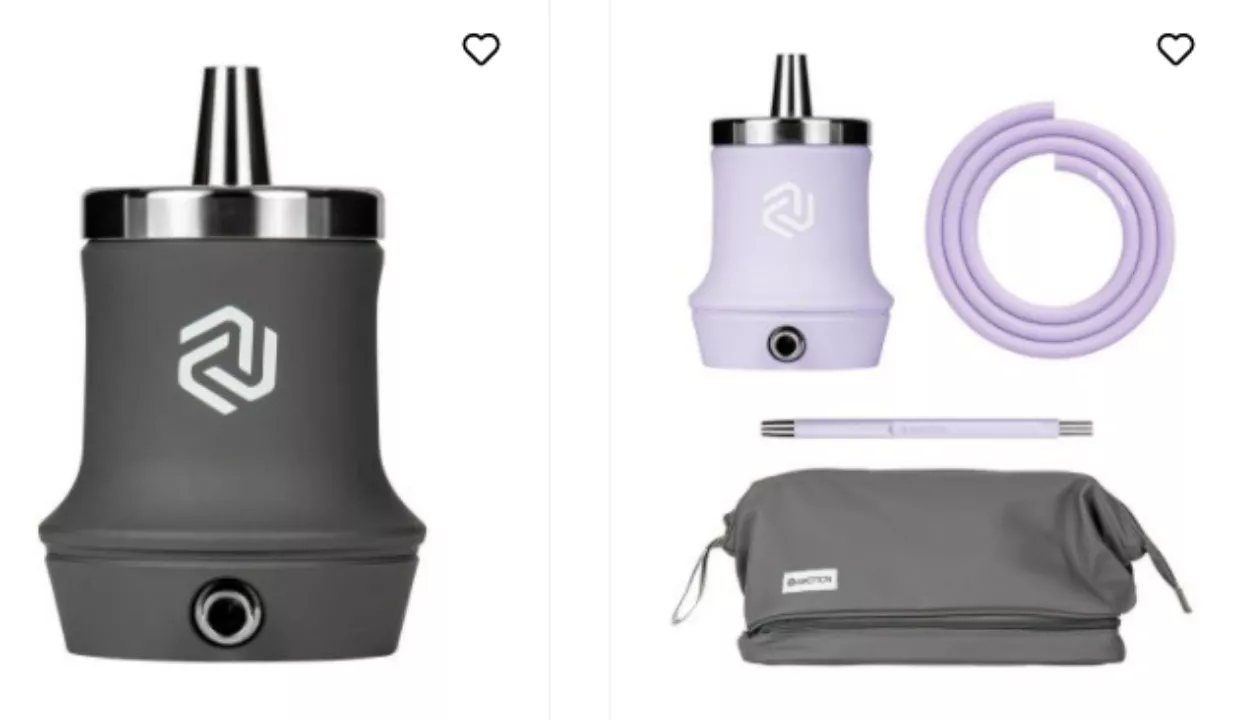

Hookah injection molding case study: This article explains the key design, material, process, quality, and production considerations that engineers and sourcing teams should evaluate.
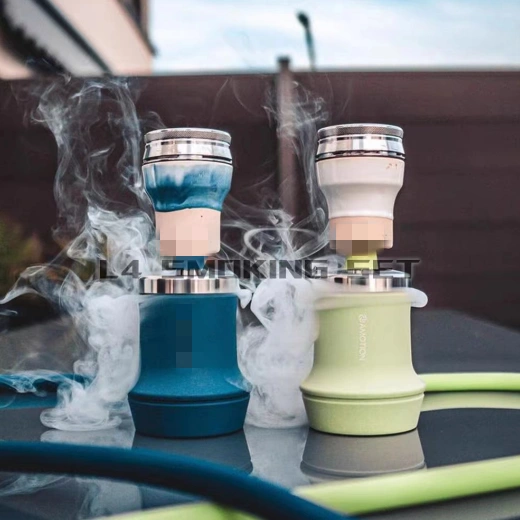
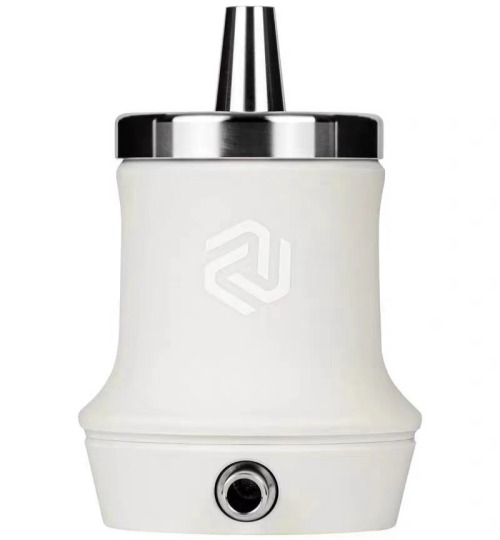
At the end of 2020, a hookah brand contacted Rilong with an initial product design and a specific surface requirement: the molded plastic housing needed a soft-touch finish rather than the feel of conventional rigid plastic. The project soon developed into a complete engineering program covering design for manufacturing, CNC prototypes, injection molds, plastic-to-metal overmolding, soft-touch finishing, sealing, assembly, printing, and packaging.
The most important result was not simply producing molded parts. During development, prototype and transportation testing exposed a structural weakness in the original joining concept. Rilong and the customer revised the assembly from ultrasonic welding to a serviceable screw-fastened connection with a silicone gasket, improving the connection between the heavy base and the main body.
Customer logos and identifying details are omitted in accordance with our non-disclosure agreement. The engineering decisions described below are limited to information approved for this project case study.
Project Requirements
- Convert the customer’s industrial design into injection-moldable components
- Create a soft-touch exterior using primer and silicone-oil surface coating
- Integrate a heavy stainless-steel base with molded plastic
- Develop reliable connections between the base, body, and accessories
- Maintain the customer’s intended appearance and product-use concept
- Verify the design through multiple CNC prototype iterations
- Manufacture the injection molds and molded components
- Complete overmolding, surface finishing, logo printing, assembly, and packaging
From Industrial Design to Manufacturable Parts
Rilong first supplied soft-touch coating samples so the customer could confirm the required surface feel and appearance. After receiving the initial design, our engineers reviewed it against injection molding and assembly requirements.
Several features were impractical for the proposed manufacturing process. Some plastic sections were excessively thick, while heavy metal elements created structural and assembly loads that could not be evaluated by appearance alone. Changing these features initially required careful discussion because the customer wanted to preserve the original design language.
The engineering objective was therefore to preserve the intended form while making the parts moldable, repeatable, and suitable for assembly. The review considered wall-thickness transitions, interfaces between plastic and metal, fastening locations, surface-finish allowances, component alignment, and the way loads would pass from the body into the base.
Using CNC Prototypes to Reduce Tooling Risk
Multiple CNC prototype iterations were produced between the initial review and final design approval. These prototypes allowed the customer and Rilong team to evaluate the product as an assembly instead of reviewing isolated CAD models.
- Overall proportions and appearance
- Fit between the main body and weighted base
- Assembly sequence and access to fasteners
- Interfaces between rigid plastic, soft material, and metal components
- Surface preparation before primer and soft-touch coating
- Handling and transportation behavior
The customer approved the developed design in March 2021, allowing production of the complete mold set to begin.
Plastic Overmolding a Stainless-Steel Base
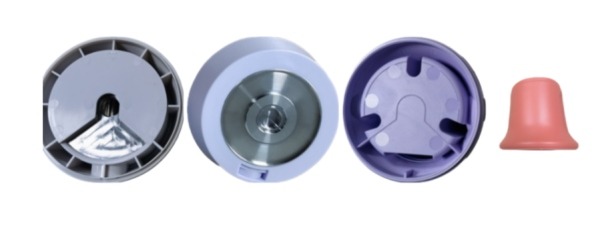
The three components on the left of the image form the product base. Plastic is overmolded around stainless-steel parts to combine the required weight and stability with the geometry needed for assembly. The red component on the right is the main molded body.
Plastic-to-metal overmolding requires control of insert location, mold loading, and the interface between the insert and molded resin. The metal component must remain correctly positioned during injection, while the surrounding plastic must fill without creating unacceptable flash, short shots, or movement of the insert.
Why the Original Ultrasonic-Welded Joint Was Changed
The original concept used ultrasonic welding to join the body and base while supporting the sealing requirement. Prototype and transportation evaluation revealed a problem: the base was heavy, and impact loads during transportation could break the connection between the main body and base.
Rather than trying to compensate by increasing weld energy or adding more plastic around the joint, Rilong discussed a structural change with the customer. The design was revised to use screw fastening, and a silicone gasket was added at the base interface to provide the required seal.
| Design stage | Connection method | Engineering result |
|---|---|---|
| Initial concept | Ultrasonic welding | Clean permanent joint, but the heavy base transferred transportation loads into the welded interface |
| Revised design | Screw-fastened joint with silicone gasket | Mechanical retention was separated from the sealing function and the assembly became easier to inspect |
This was a significant project decision. It shows why joining methods should be selected according to actual loading and product use, not only appearance or assembly speed.
Soft-Touch Surface Finishing
The customer wanted the exterior to feel softer and more refined than untreated molded plastic. The selected finishing route used surface preparation, primer, and silicone-oil coating. Samples were submitted before the complete production process was approved.
A soft-touch finish adds process steps beyond injection molding. Molded surfaces must be consistent because sink marks, flow lines, contamination, or handling damage can remain visible after coating. Surface preparation, coating thickness, curing, handling, and adhesion therefore need to be controlled as part of the finished-product process.
Manufacturing Processes Used
| Prozess | Application in the project |
|---|---|
| Injection molding | Main body, base geometry, and other plastic components |
| Plastic-to-metal overmolding | Plastic molded around stainless-steel base parts |
| Soft-over-hard overmolding | Components requiring a combination of rigid support and soft material |
| Surface coating | Primer and silicone-oil coating for the specified soft-touch finish |
| Silk-screen printing | Product logo and required surface graphics |
| Mechanical assembly | Screw fastening, gasket installation, hardware, and accessory assembly |
| Verpackung | Finished-product packing after inspection |
Quality Control Across Molding and Assembly
Because the project combined molded plastic, metal inserts, soft materials, coating, printing, and final assembly, quality could not be verified at only one stage. Inspection needed to follow the product through the complete manufacturing route.
- Insert position and plastic coverage after overmolding
- Flash, incomplete filling, sink marks, and cosmetic surface defects
- Fit between the body, base, gasket, and hardware
- Fastener engagement and assembly consistency
- Coating appearance and adhesion
- Logo position and print quality
- Finished-product appearance before packaging
After the product entered the market successfully, the customer expanded Rilong’s scope to include final assembly and packaging. This moved responsibility from supplying individual components to delivering a more complete contract-manufacturing solution.
Production and Assembly Videos
These videos show selected production and assembly stages. Customer logos and confidential details have been omitted.
Component Production
Product Assembly
Finished Product Inspection
Finished Product Gallery
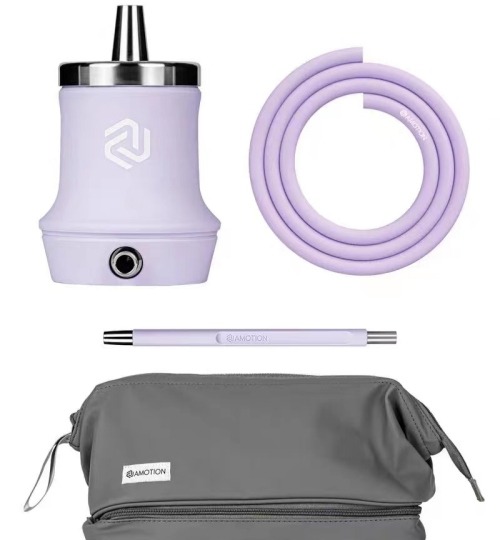
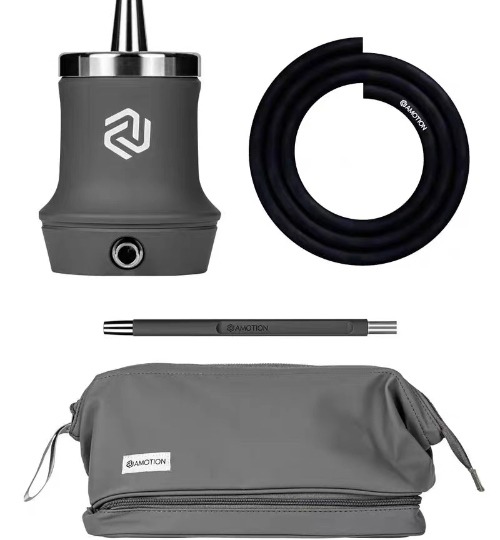
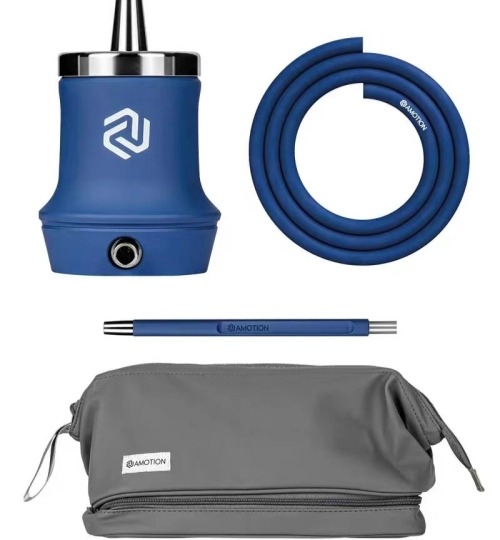
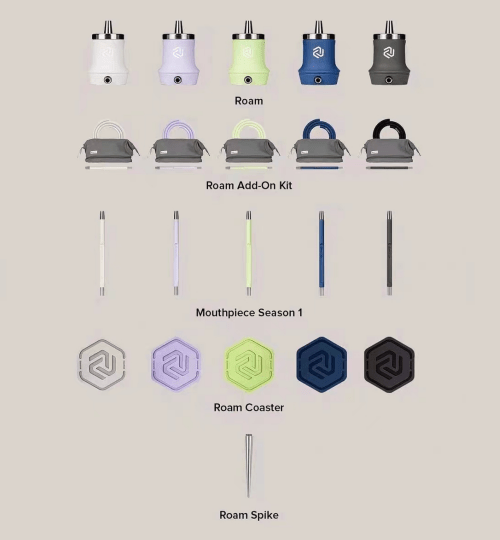
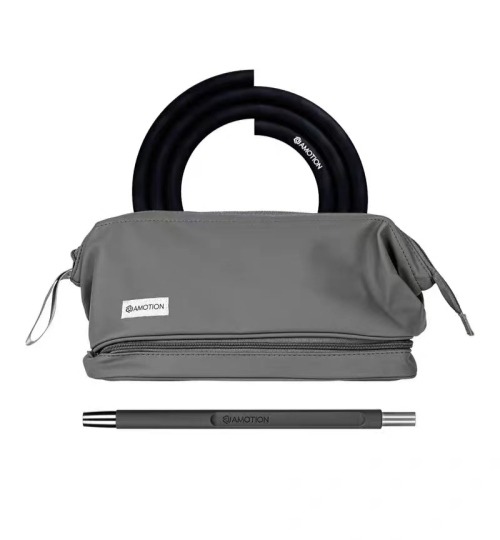
Project Result
The project moved from an initial industrial design to approved CNC prototypes, a complete mold set, stable component manufacturing, surface finishing, assembly, and packaging. The revised body-to-base connection addressed the weakness identified during transportation evaluation, while the silicone-oil coating delivered the customer’s required soft-touch appearance.
This case demonstrates why early DFM, physical prototypes, and assembly-level testing are important for products that combine molded plastic with heavy metal components. Finding the joint weakness before wider production allowed the fastening and sealing functions to be redesigned before they became a recurring field problem.
Need Injection Molds for a Multi-Material Product?
Rilong supports projects involving mold design and tooling, plastic injection molding, overmolding and insert molding, surface finishing, assembly, and packaging. Send our engineering team your CAD files or prototype for a manufacturability review.
Note: In accordance with our NDA, product logos and identifying customer information have been omitted.