





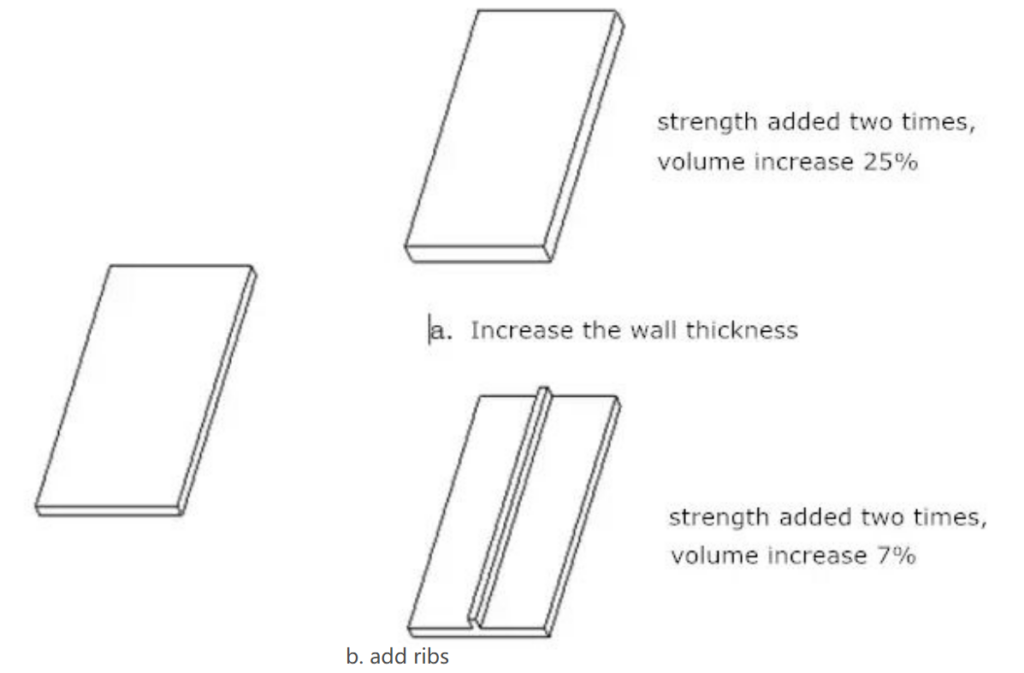
When engineers need a plastic part to be stronger, the first instinct is often to increase wall thickness.
In practice, this usually causes more problems than it solves.
Thicker walls lead to sink marks, warpage, longer cooling times, and higher material costs. That’s why experienced mold designers turn to ribs instead.
But rib design isn’t just about adding a few features. It’s about understanding how load travels through the part, how plastic flows in the mold, and how the part will behave after molding.
Here are the principles we apply most often.
1. Ribs, Not Thickness
Adding thickness increases strength — but also introduces shrinkage, warpage, and cooling challenges.Ribs add stiffness locally, without the side effects of thick walls.
A good rule of thumb: rib thickness should be around 50–60% of the main wall thickness to avoid sink marks at the base.
2. Load Direction Comes First
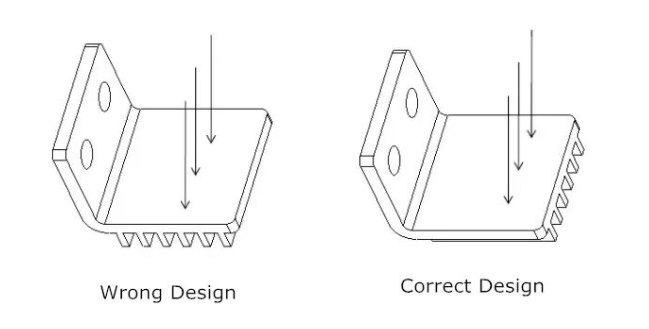
A rib is only effective if it runs in the direction of the load.
- For bending loads, ribs should be perpendicular to the neutral axis.
- For torsional loads, cross or diagonal rib patterns work better.
- For localized loads, ribs should connect directly to the load point.
Putting ribs in the wrong direction adds weight, not strength.
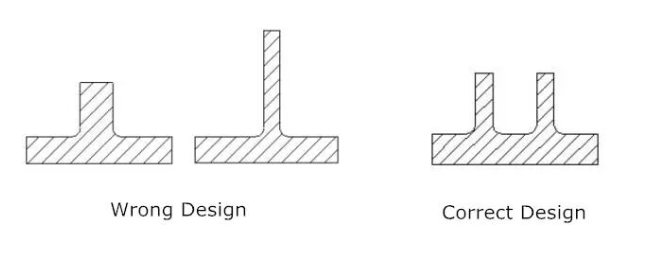
3. Several Thin Ribs Beat One Thick Rib
A single thick rib tends to shrink at the base and concentrate stress at the root.
Multiple thinner ribs distribute the load more evenly and reduce the risk of sink marks and stress cracking.
The trade-off: too many ribs too close together can complicate mold cooling. Balance is key.
4. Smooth Transitions Matter
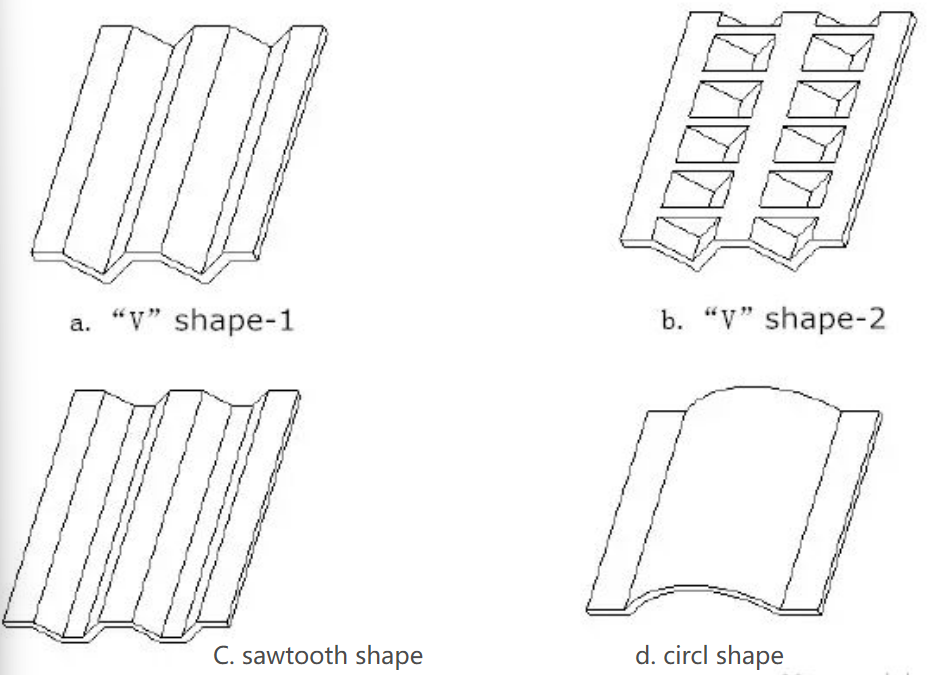
Where a rib meets the main wall, a sharp corner creates a stress concentration.
Adding a radius at the base, and avoiding sudden wall thickness changes, helps the part survive repeated loading and reduces warpage risk.
5. Watch Where the Weld Lines Land
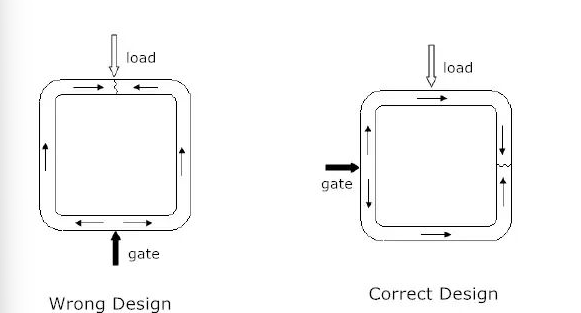
Weld lines form where two flow fronts meet. They’re the weakest points in a molded part — often only 50–80% of the base material’s strength.
If a weld line sits on a high-stress area, it becomes a failure point.
In practice, eliminating weld lines entirely isn’t always possible. The goal is to move them away from critical load-bearing zones by adjusting gate location, flow balance, or mold temperature.
In Summary
| Principle | Why It Matters |
|---|---|
| Ribs over thickness | Avoids sink, warp, and waste |
| Load direction first | Ensures the rib actually works |
| Multiple thin ribs | Better stress distribution |
| Smooth transitions | Reduces stress concentration |
| Manage weld lines | Avoid failure at weak points |
Rib design isn’t complicated — but it does require thinking beyond the drawing. It’s about understanding how the part will be molded, how it will be loaded, and how it will perform over time.
If you’re working on a part that needs more strength, or dealing with warpage or weld line issues, our engineering team is always happy to review the design and share our perspective.
RiLong Precision Mold Co., Limited
Precision mold design and manufacturing — from DFM to mass production.