






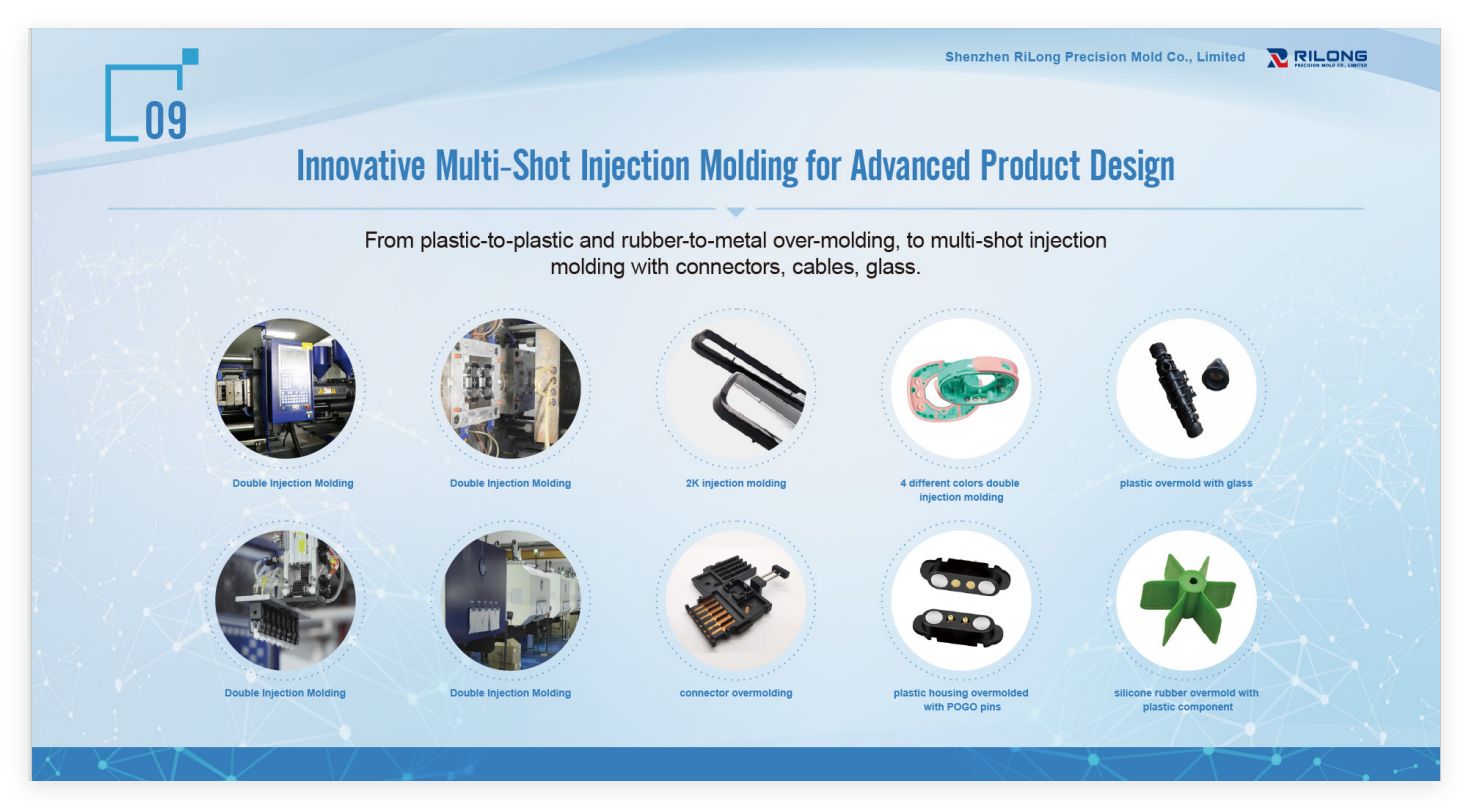

Incorporating multi-material designs (e.g., rigid plastic + soft TPE) into products not only enhances grip comfort but also adds functionalities such as waterproofing and shock absorption. However, choosing between Two-Shot Molding and Overmolding is often the first major challenge engineers face.
1. Process Fundamentals: Integrated Molding vs. Secondary Encapsulation
- Two-Shot Molding (2K Molding): This is essentially “integrated molding.” It relies on specialized two-shot injection molding machines to inject two different materials within a single molding cycle using one precision mold. After the first material is injected, the mold core rotates or slides, and the second material is injected immediately. Due to the minimal interval between shots under high temperature and pressure, this process achieves molecular-level bonding between the materials.


- Overmolding: This is essentially “secondary encapsulation.” The substrate (rigid plastic) from the first shot must be completely cooled and removed, becoming an independent semi-finished part. This substrate is then placed (manually or by robot) into a second mold, where the second material (e.g., soft TPE) is injected over it. The bond strength relies primarily on physical interlocking via undercuts or textured surfaces on the substrate.


2. Selection Logic Flowchart
To further simplify your decision-making process, follow this logical path:
- Step 1: Check Volume. Is it high-volume production (millions of parts)? -> Choose Two-Shot Molding. Is it low-volume prototyping or a few thousand parts? -> Choose Overmolding.
- Step 2: Check Bond Requirements. Does the TPE need to bond so strongly to the ABS that it’s impossible to peel off by hand? -> Choose Two-Shot Molding. Is it acceptable to design mechanical snaps or screws to hold the soft component? -> Overmolding is feasible.
- Step 3: Check the Substrate Material. Is the base material metal or a PCB board? -> Forced choice: Overmolding (specifically Insert Molding). Is the first-shot plastic prone to melting or deforming under heat again? -> Be cautious with Overmolding (risk of collapsing the substrate). Prioritize Two-Shot Molding in this case.
3. Decision Matrix: Quantifying Your Choice Across Four Dimensions

الخاتمة
Two-Shot Molding and Overmolding are not competing processes but rather complementary solutions. Two-Shot Molding addresses the demands for precision and longevity in high-end products, while Overmolding covers a vast spectrum of customized, cost-sensitive applications with its inherent flexibility. By clearly defining your product’s positioning and scale of production, you can easily navigate to the optimal manufacturing solution.